
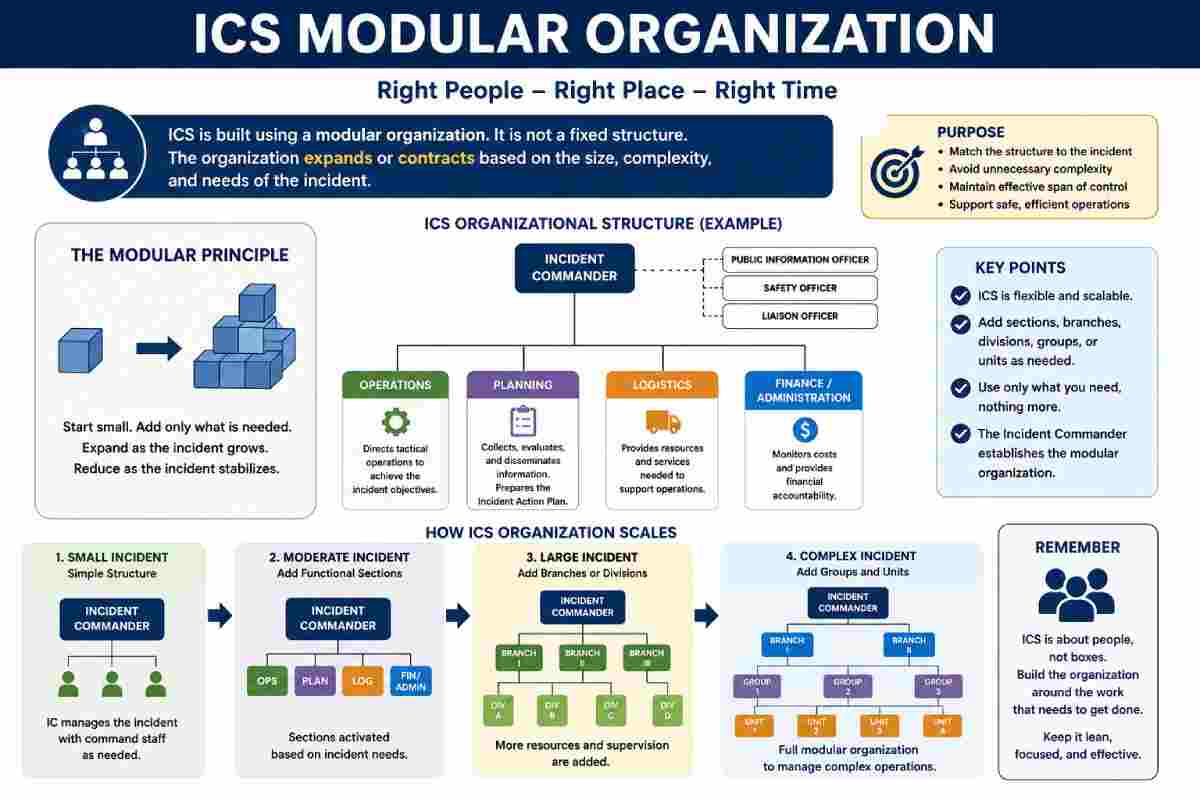
In the Incident Command System (ICS), the modular organization is the feature that allows the incident structure to grow or shrink based on the actual needs of the event. The responsibility for establishing that organization falls on the Incident Commander. In situations using Unified Command, that responsibility is shared by the unified command structure. FEMA also notes that in EOC settings, the EOC Director follows the same modular principle for the support organization there.
Table of Contents
Definition of ICS Modular Organization

Modular organization means the incident structure is not fixed. Instead, it expands or contracts depending on the size, complexity, and demands of the incident. FEMA describes ICS as a system that develops in a modular fashion so it can match the incident’s scope without creating unnecessary layers of management.
Put simply, if an incident is small, the organization stays small. If the incident grows, the organization grows with it. That flexibility is one of the biggest reasons ICS works so well in real emergencies. FEMA training materials specifically state that the Incident Commander must activate complete, intact teams to staff the functional areas as needed.
Who Is Responsible?
The best answer, in standard ICS language, is:
The Incident Commander is responsible for establishing the ICS modular organization.
If the incident is managed under Unified Command, then the Unified Command shares that responsibility. FEMA’s NIMS materials also explain that the jurisdiction or organization with primary responsibility designates the person at the scene who establishes command.
That means the Incident Commander is not just “in charge” in a general sense. The IC actively decides what functions are needed, what positions must be filled, and how the organization should expand or contract as the incident changes. FEMA’s ICS review material also says the Incident Commander is responsible for establishing the ICS organization needed to manage the incident.
Why Modular Organization Matters

A modular structure helps incident managers avoid two common problems: overbuilding and underbuilding the response. If the team is too large, communication gets messy. If it is too small, important tasks get missed. Modular organization keeps the response balanced, practical, and focused. FEMA explains that this approach helps maintain an effective span of control and allows the organization to be built around only the functions that are truly needed.
In the real world, that means a single officer may initially cover multiple duties at a small incident. Later, as complexity increases, those duties can be divided into separate sections, branches, divisions, groups, or units. This is not a sign of confusion; it is a sign that ICS is adapting correctly.
How the ICS Structure Expands
ICS starts with the Incident Commander and then adds only the roles required to handle the incident safely and efficiently. FEMA training explains that the organization may expand into Command Staff and General Staff roles, with functions such as Operations, Planning, Logistics, and Finance/Administration being added when needed.
Common ICS Expansion Pattern
| Incident Size | Typical Structure | What Happens |
| Very small | Incident Commander only | One person handles overall management and direct supervision. |
| Small but active | IC + a few assigned roles | Tasks are shared, but the structure stays simple. |
| Moderate | IC + Command Staff + General Staff | Sections and supervisors are added to control workload. |
| Large/complex | Full ICS organization | Multiple branches, divisions, groups, and units may be established. |
This pattern reflects the core ICS idea: use only what you need, and add more structure only when the incident demands it. FEMA’s materials repeatedly emphasize this flexible and scalable design.
Comparison Table: Modular Organization vs. Rigid Organization
| Feature | Modular Organization | Rigid Organization |
| Structure | Flexible and scalable | Fixed and less adaptable |
| Growth | Expands as incident complexity grows | Often requires a full structure even for minor incidents |
| Efficiency | Uses only needed positions | May create unnecessary layers |
| Communication | Easier to manage through clear span of control | Can become overloaded or confusing |
| Best for | Emergencies, disasters, changing incidents | Stable, routine, unchanging environments |
| ICS fit | Directly matches NIMS/ICS design | Does not match ICS principles well |
This comparison shows why ICS is preferred in emergency management. A modular system can handle a small roadside accident just as well as a large multi-agency disaster, because the structure changes with the incident instead of forcing the incident to fit the structure.
Comparison Table: Incident Commander vs. Unified Command vs. EOC Director
| Role | Main Responsibility | Relation to Modular Organization |
| Incident Commander | Overall leadership of the incident response | Establishes and expands the ICS modular organization. |
| Unified Command | Shared command when more than one agency/jurisdiction has authority | Jointly manages incident objectives and the modular structure. |
| EOC Director | Manages the Emergency Operations Center structure | Uses modular organization in the EOC setting, similar to ICS. |
FEMA’s NIMS guidance makes the distinction clear: ICS is led on scene by the Incident Commander or Unified Command, while EOCs also use modular organization under the EOC Director. That is why the exact wording of the question matters. For ICS, the strongest answer is Incident Commander.
What the Incident Commander Actually Does
The Incident Commander does far more than simply “supervise.” FEMA training says the IC provides overall leadership, establishes incident objectives, directs the Incident Action Plan, ensures safety, delegates authority, and coordinates with the EOC and other stakeholders. The IC also establishes the ICS organization needed to manage the incident.
That is why the IC is the right answer for modular organization. The IC sees the whole incident picture and decides what structure is necessary for safe and effective operations. A strong IC keeps the organization lean when the incident is small and builds it out when the incident becomes more complex.
Simple Explanation for Exams or Interviews
If you need a short, direct answer, use this:
The establishment of the ICS modular organization is the responsibility of the Incident Commander.
In Unified Command, that responsibility is shared by the Unified Command team.
Key Points to Remember
- ICS is designed to be flexible, not fixed.
- The Incident Commander establishes the modular organization.
- Unified Command shares that role when multiple authorities are involved.
- The organization expands only when the incident requires it.
- The purpose is better control, better communication, and safer operations.
Why This Principle Is So Important in the Field
For emergency response-as with all things in life-speed is good, structure is better. Modular organization is key to preventing confusion, avoiding overlap, and keeping the span of control down to a manageable level. This is even more critical in a multi-agency incident, one with multiple hazard environments, or a prolonged duration scenario. FEMA’s NIMS doctrine treats modular organization as one of the core management characteristics that makes ICS effective in real operations.
It’s also provides clarity. If everyone knows where they’re accountable and to whom, and which function they support, there’s much more structure and control in the response. Clarity is one of the reasons the ICS framework is so pervasive throughout emergency services and incident command.
Final Thought
The answer is easy, the thought process behind it is quite profound. The IC is responsible for setting up the ICS modular organization because the IC needs to mold the organizational framework around the real demands of the incident. As the incident expands, the organization expands. When the incident goes down, so does the organization. That’s the power behind the ICS. It’s realistic and responsive.
Also Read: https://www.menshealthupdates.com