
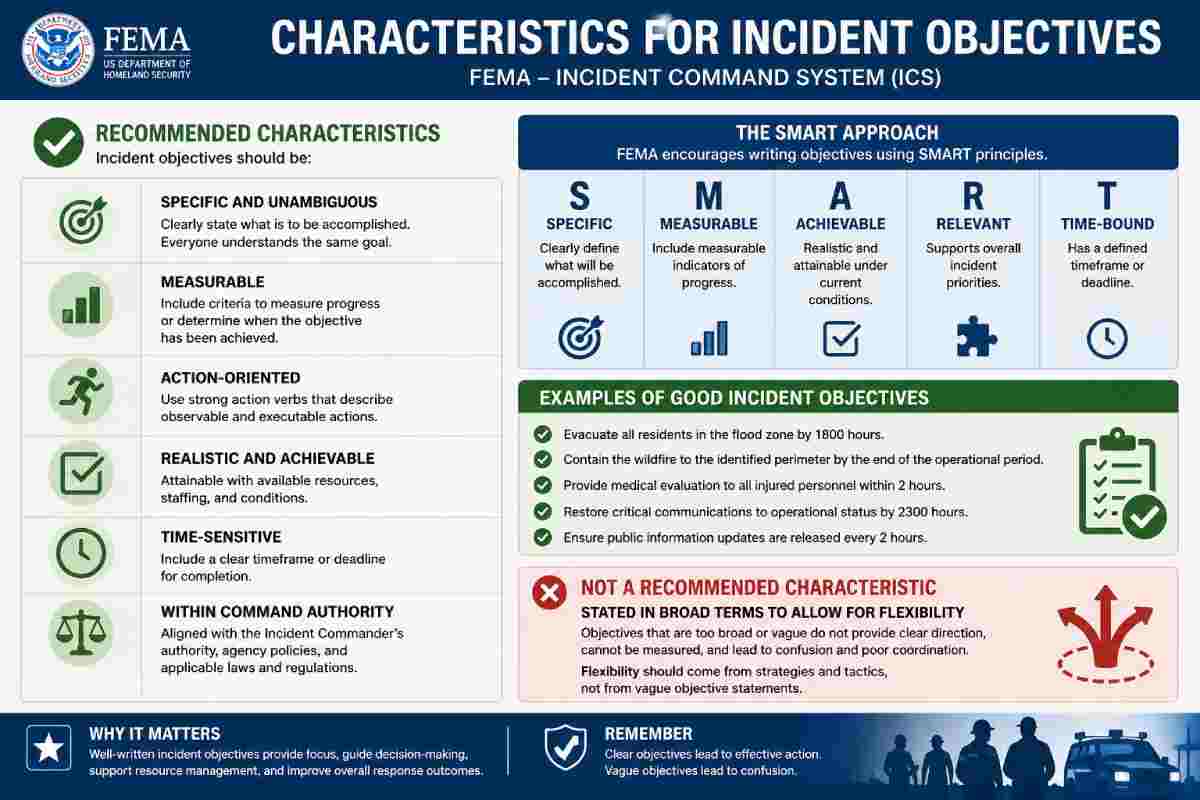
Correct: worded in general terms for flexibility. According to FEMA’s guidelines for Incident Objectives, incident objectives should be: SMART – Specific, Measurable, Actionable, Realistic and Time-bound. Essentially, they must be clear enough to act on without them and general enough that those acting on them are not stuck on the “why”.
Table of Contents
Definition: What Are Incident Objectives?

Incident objectives are what the incident team wishes to achieve within an operational period. FEMA guidance regarding ICS states that the incident objectives are the basis for selecting the strategies and tactics; incident objectives are designed to be appropriate and attainable, to be specific and measurable and to permit tactical and strategic options to be developed. The objectives are part of the incident action plan which states what is required to be achieved by whom and in what order.
Simply, the incident objectives are the “destination” and the strategies and tactics are the “journey” and “method of transport”.” Hence, there is a need for incident objectives to be very specific; the options and choices involved in developing the strategies and tactics provide the flexibility. The training material produced by FEMA has this clearly identified.
The Best Answer in Plain English
If a question asks which characteristic is not recommended for incident objectives, the best choice is usually:
“Stated in broad terms to allow for flexibility.”

Why? Because incident objectives should be written to give direction, not ambiguity. SMART style objectives as described in FEMA ICS Form 202 directions should be defined as concise and clear statement for response operations. FEMA also refers to criteria such as: measurable, specific, action oriented, realistic, time sensitive.
Comparison Table: Recommended vs. Not Recommended Characteristics
| Characteristic | Recommended? | Why it matters |
| Specific and unambiguous | Yes | Everyone understands the same goal the same way. |
| Measurable | Yes | Success can be checked, tracked, and reported. |
| Action-oriented | Yes | Uses action verbs so the team knows what to do. |
| Realistic / achievable | Yes | The objective must fit available resources and conditions. |
| Time-sensitive | Yes | There must be a clear timeframe for completion. |
| In accordance with the Incident Commander’s authority | Yes | Objectives must stay within legal and policy limits. |
| Stated in broad terms to allow for flexibility | No | Too vague to guide operations effectively. Flexibility belongs in strategy and tactics, not in an unclear objective. |
Why “Broad Terms” Is the Wrong Choice
At first glance, “broad terms” can sound helpful. After all, emergencies change quickly, and incident response does need some adaptability. But FEMA’s guidance separates that adaptability from the objective itself. The objective should stay precise and measurable, while the response can still shift through strategies and tactics as the situation develops.
That is the key idea many learners miss. A good objective says what must be accomplished. It does not wander into general statements like “improve the situation” or “handle the problem as needed.” FEMA explicitly says incident objectives must describe what must be accomplished and provide substantive direction for work at the incident.
What a Strong Incident Objective Looks Like
A strong incident objective is short, direct, and practical. It should point the response team toward a result that can be observed and verified. FEMA’s ICS 202 instructions emphasize that the objectives should be clear, concise, and listed in priority order when appropriate.
Here is the feel of a strong objective:
- Evacuate the affected zone by 1800 hours.
- Contain the fire to the east sector.
- Restore critical communications by the end of the operational period.
- Protect life safety and stabilize the incident area.
These examples are better than broad wording because they can be judged later. Did it happen? Was it completed on time? Was it realistic? That is the standard FEMA training pushes through the SMART model and the ICS planning process.
A Simple Way to Remember It
Think of incident objectives as a response team’s compass. A compass has to point clearly. If it wobbles in every direction, nobody knows where to go. FEMA’s guidance is built on this same idea: objectives must be measurable and realistic, and they must give the incident team enough direction to act.
A useful memory trick is this:
Good objective = specific + measurable + doable + time-bound
Bad objective = vague + broad + hard to verify
Short Explanation for Exams or Interviews
In an exam, interview or training quiz you should answer:
Incident objectives should not be too generic so that it can be applied in any circumstances and they should be Specific, Measurable, Achievable and Time-bound.
This answer corresponds to FEMA’s ICS training and the NIMS glossary. Incident objectives are considered measurable, realistic and achievable and used to select strategies and tactics.
Why This Matters in Real Incident Management
In the real world incident operations, unclear goals can cause confusion very quickly. If you don’t have specific metrics that indicate when you have succeeded, then each part of the team may be aiming for different things, which will cause wasted time, loss of resources and increase danger.
FEMA’s planning guidance places incident objectives at the center of the Incident Action Plan because they shape the work for the operational period.
Clear objectives also support command discipline. According to FEMA, incident objectives are required to be within the authority of the Incident Commander and the governing rules, regulations, and policies of the agency or jurisdiction. It’s not just a hope list but is a controlled and specific direction.
Bullet-Point Summary
- Incident objectives are the outcomes the incident response is trying to achieve.
- FEMA guidance says they should be specific, measurable, action-oriented, realistic, and time-sensitive.
- They are used to choose strategies and tactics.
- The not recommended characteristic is stating objectives in broad terms to allow for flexibility.
- Flexibility belongs in the strategy and tactics, not in a vague objective statement.
Final Answer
“stated in broad terms so as to offer maximum flexibility”. The objective in this case is not included as a desired feature because clarity would be compromised and problems during vital functions could result. Flexibility is vital in response, but it should be in the plan to obtain the objective, not in the statement of the objective itself.
Well-defined incident objectives enable easier communications, improve coordination, minimize errors, and quick response during urgent incidents in actual incident management situations. Whether it’s related to a natural disaster, a public safety incident, a medical emergency, or a large complex incident, clear incident objectives facilitate focus on the mission.